From 1 October 2026 Australian businesses can no longer add a surcharge to eftpos, Mastercard or Visa payments. The fix many are reaching for is the opposite move: a discount for paying in cash or by PayID. Some businesses are going further and dropping cards altogether (Yahoo Finance), and a discount of up to 10 per cent for paying by cash or PayID has been floated as a way to steer customers (Newcastle Herald, via AAP).
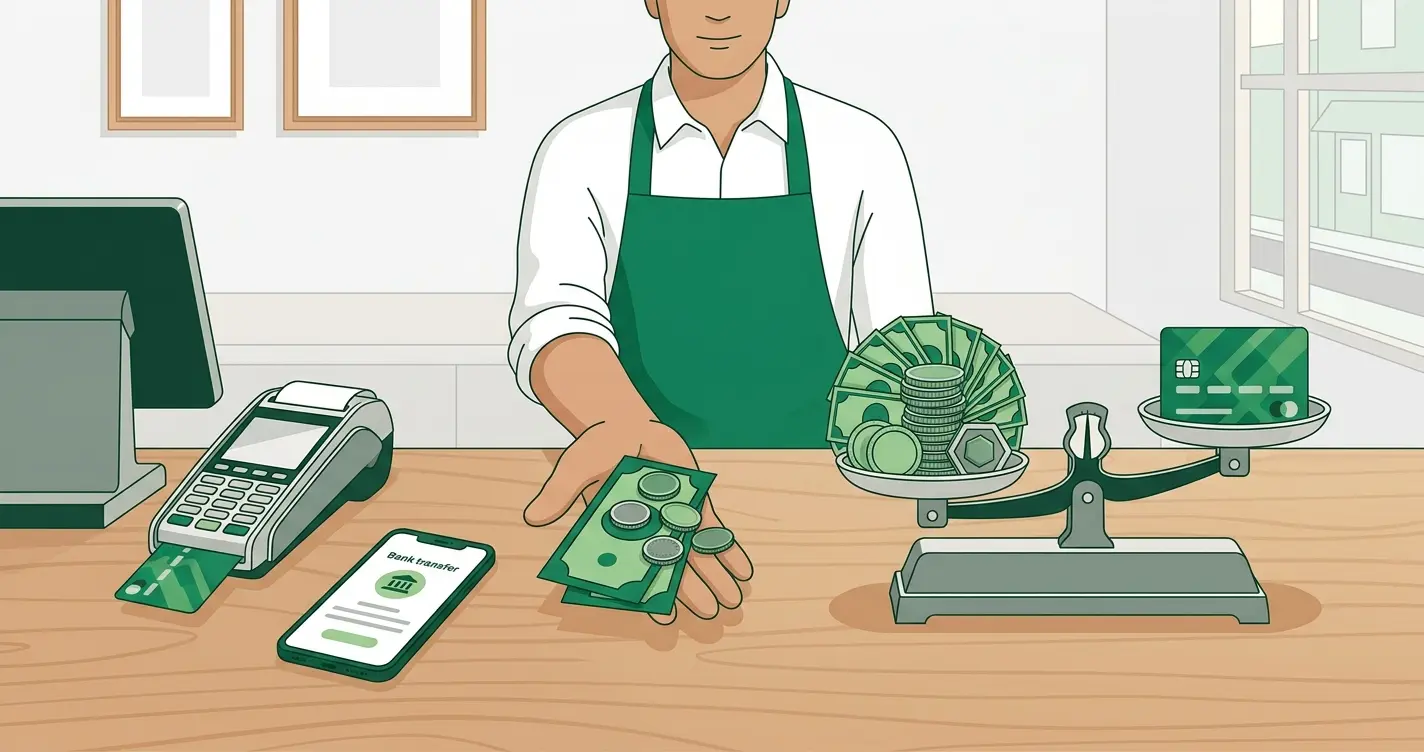
The discount is legal. The maths is the problem. A card payment costs a business a percentage of the sale, and on every published flat rate in our dataset that percentage is a small fraction of 10 per cent. Offer a 10 per cent cash discount and you can hand back six times what the card would have cost you, before counting the customers who were paying cash anyway.
Is a cash discount allowed after the surcharge ban?
Yes. The Reserve Bank's ban covers surcharges on eftpos, Mastercard and Visa. It does not stop discounts. The RBA says "businesses can continue to offer discounts for particular payment methods" (RBA FAQ).
There is one condition. The ACCC says the price you display "must be the full price they will pay if they do not receive the payment method discount" (ACCC, card surcharges). It also says businesses should not "display only the discounted price" or "make the discounted price more prominent than the full price", and that the discount "should be clearly disclosed before consumers choose to book, order or pay". Marking prices at the cash price and adding the difference back at the terminal is a surcharge by another name.
What a card payment actually costs you
Across the payment providers we track, published flat in-person rates run from 1.1% to 1.7%, with a median of 1.3%. That percentage is what you save when a customer switches from card to cash.
A 10 per cent discount gives away 10 per cent. Divide one by the other and you have the multiple. At any card rate below 1.67 per cent, a 10 per cent discount is more than six times the fee it replaces, and the lower your rate, the worse the trade. Some rates are about to fall further: Westpac announced on 23 September that its flat rate for eligible customers on its EFTPOS terminals drops from 1.20 per cent to 0.79 per cent on 1 October (Westpac media release), and CommBank's flat in-store rate falls from 1.10 per cent to 0.99 per cent on the same day (SmartCompany). Against a card fee under 1 per cent, a 10 per cent cash discount is more than ten times the saving. The one thing that narrows the gap is a fixed fee per transaction: on a plan that adds a few cents to every tap, a very small sale carries a higher effective rate, so the multiple on a cheap coffee is lower than on a large purchase.
The bigger cost: customers who already pay cash
The multiple is only half of it. A discount cannot be offered to new cash customers alone. Everyone who was already paying cash gets it too, and they were costing you no card fee in the first place.
Reserve Bank data, reported by AAP, puts cash at "barely 15 per cent of all counter purchases", counted by number of purchases rather than by value. Every one of those purchases gets the discount. A 10 per cent cash discount hands 10 per cent of those sales straight back, with no card fee saved on any of them. For many businesses that line is larger than the whole saving from customers who switch.
Put your own numbers in below. The provider list and the starting rate come from the same live pricing data as our comparison table.
Cash discount calculator
See what a cash or PayID discount gives away, against the card fees it saves you.
Prefilled with the median published in-person rate. Use the rate on your statement.
Percentage fee only. A fixed per-transaction fee is not included.
All in-store sales, cash and card.
Share of your sales, by value, paid in cash or PayID today.
Share of card sales you expect to move to cash or PayID.
The discount you would offer for cash or PayID.
The discount costs you
$596/mo
$7,152 a year
On every sale that switches, a 10% discount gives away 7.7 times the 1.3% card fee it saves.
- Card fees saved on switched sales
- +$44
- Discount given to customers who switch
- -$340
- Discount given to customers who already paid cash
- -$300
- Net each month
- -$596
Break-even: a discount of about 1.3% pays for itself on switched sales alone, and about 0.69% once your existing cash customers get it too.
Estimates only. Excludes fixed per-transaction fees and the cost of handling cash.
Compare all payment providersWhat a cash discount that pays for itself looks like
On sales that switch from card, a discount pays for itself only up to your card rate. At the median published rate of 1.3%, a 1.3% cash discount is break-even on those sales, and anything above it is a cost. Once your existing cash customers are counted, the break-even discount is lower still, which is the second break-even figure the calculator shows.
That does not make a cash discount wrong. A business may want one for reasons the calculator does not price: customers who value it, a quieter terminal on busy days, or simply matching the shop next door. The point is to set the number knowing what it costs, rather than picking 10 per cent because it sounds generous.
Cash also carries its own costs that the calculator leaves out on purpose, because they vary so much between businesses: counting and banking time, cash deposit fees, and the risk of holding it. Those push the true break-even lower again.
Is PayID different?
A PayID payment goes straight from the customer's bank account into yours. None of the payment providers we track takes PayID at the counter, because it does not run through a card terminal at all, so there is no card fee on it and no cash to count. That makes a PayID discount cheaper to run than a cash one, but the maths above is the same: the discount goes to every customer who pays that way, including the ones who would have paid by PayID without it.
A cheaper way to cut the cost of card payments
If the aim is to stop card fees eating into margin now that you cannot pass them on, the cheaper lever is the rate itself. Published in-person rates differ between providers, and some banks are cutting theirs as the ban starts. A lower rate cuts the cost of every card sale, including the customers who will never switch to cash, and it does not hand any of your margin back to the ones who already do.
Compare every provider's published rate, monthly fee and hardware cost on our payment providers comparison, and see what the ban itself costs you with the surcharge ban calculator. For the full picture of what goes into a card fee, read our plain-English guide to merchant fees and what changes on 1 October.
Frequently asked questions
Can I still offer a cash discount after 1 October 2026?
Yes. The RBA and the ACCC both confirm businesses can offer a discount for paying by a particular method, such as cash or PayID. The price you display must be the full price a customer pays without the discount.
How big should a cash discount be?
On sales that switch from card to cash, a discount breaks even at your own card rate, and published flat in-person rates run from 1.1% to 1.7%. A larger discount costs more than the card fee it saves, and it also goes to customers who were already paying cash.
Is a cash discount the same as a surcharge?
No, as long as the displayed price is the full price. Showing a lower cash price and charging card users more at the terminal is treated as a surcharge, which is banned on eftpos, Mastercard and Visa from 1 October 2026.