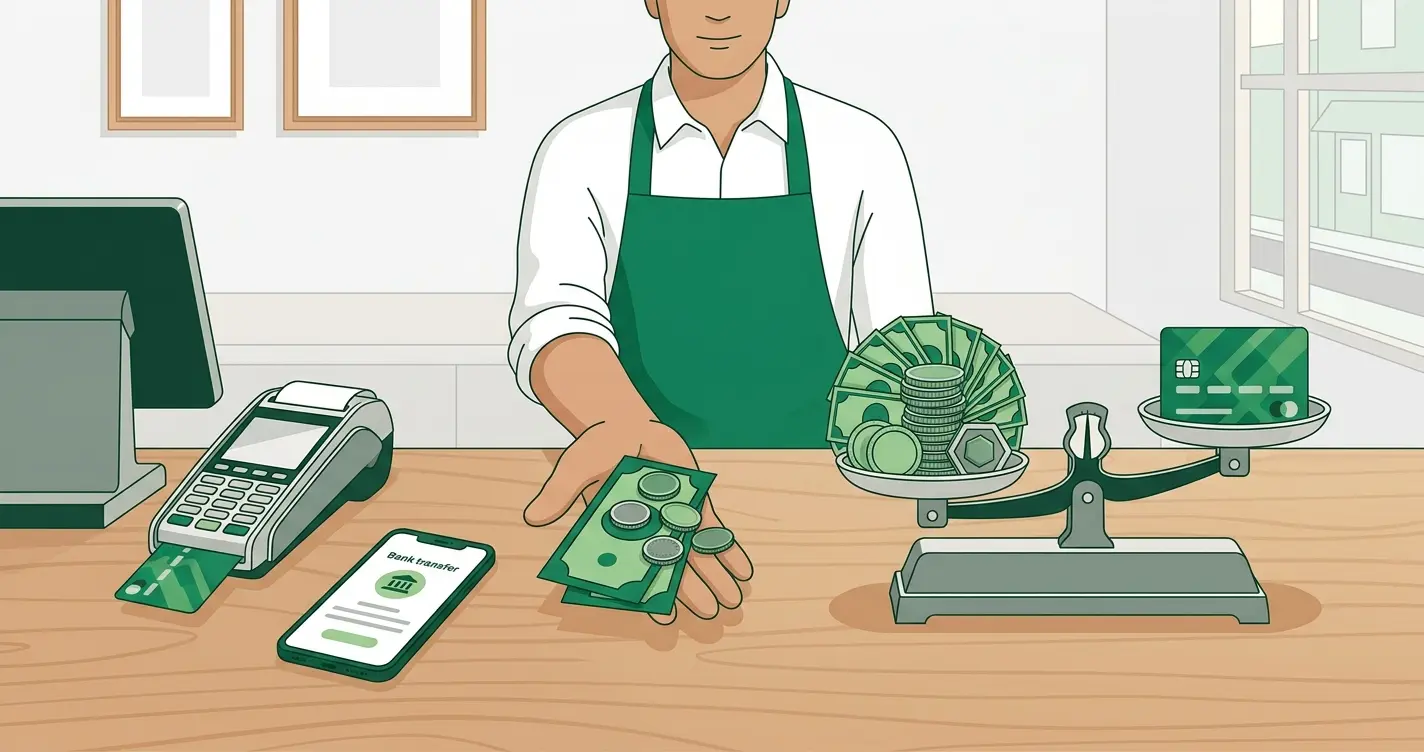
From 1 October 2026, Australian businesses can no longer add a surcharge to customer payments made on EFTPOS, Visa, or Mastercard. The Reserve Bank of Australia announced the change on 31 March 2026 as part of a wider reform package that also caps interchange fees on consumer credit cards at 0.3% and tightens transparency on wholesale payment costs.
The RBA estimates that the interchange caps alone will cut merchants' wholesale card payment costs by around $910 million a year. Every business that accepts a card is affected. If you run a cafe on a zero-cost EFTPOS plan, take Visa in your online checkout, or tap a customer's card at a market stall, the rules that have applied for the past decade are changing. To put a number on it for your own business, the surcharge ban calculator estimates how much surcharge revenue the ban removes and how much of the provider fee you will start absorbing from 1 October. The practical steps to take are at the bottom of this article.
What the RBA actually announced on 31 March 2026
On 31 March 2026, the RBA released its final response to the Merchant Card Payment Costs and Surcharging review. Three reforms sit at the centre.
First, the RBA is removing surcharging on EFTPOS, Visa, and Mastercard, effective 1 October 2026. The mechanism is worth being precise about: the RBA is not legislating a ban. The Payments System Board is lifting its long-standing prohibition on "no-surcharge" rules for the designated networks, and expects the card schemes to then impose their own no-surcharge rules, as has happened in other countries. The RBA has also said that if surcharging continues after the prohibition is lifted, it could recommend the Government legislate a ban. The stated reason is price transparency: when a card surcharge sits at the bottom of a receipt, customers cannot easily compare the headline price of one business against another. For a merchant the practical effect is the same, from 1 October you will not be surcharging Visa, Mastercard, or EFTPOS.
Second, the cap on interchange fees for domestic consumer credit cards drops from the current average of around 0.5% to 0.30% on the same date. The wholesale cost of processing a Visa or Mastercard credit transaction therefore falls materially for the first time since 2017.
Third, the RBA will publish merchant-fee data twice a year by provider and by card scheme. The transparency rule is intended to make it harder for acquirers to obscure pricing differences and easier for small businesses to compare offers.
The designation covers eftpos, Mastercard, and Visa, and on all three it covers debit, prepaid, and credit alike, whether the card was issued in Australia or overseas. The networks outside the designation were free to carry on, but the RBA reports that American Express, UnionPay and PayPal have also decided to remove surcharging (PayPal's rule takes effect on 5 October), and CommBank reports that JCB is doing the same. Diners Club is not on the RBA's list, but do not read that as permission: Adyen tells its merchants that Diners surcharging ends on 1 October too, and several providers are switching surcharging off for every card type they process, so whether you can still surcharge a Diners card depends on your provider. Buy Now Pay Later sits outside all of this, and the individual BNPL providers (Afterpay, Zip, Klarna) set their own merchant rules, several of which prohibit surcharging anyway.
Source: Reserve Bank of Australia, Review of Merchant Card Payment Costs and Surcharging: Conclusions Paper, March 2026.
The timeline at a glance
Here is the sequence of dates and what each one means for a merchant.
| Date | What changes | Who it affects |
|---|---|---|
| 31 March 2026 | RBA announces final reforms | Industry and merchants put on notice |
| April to August 2026 | Industry consultation closes on implementation detail | Acquirers and PSPs update plans |
| 1 October 2026 | Surcharge removal and the domestic interchange caps take effect | Every business accepting cards |
| 1 April 2027 | Interchange caps extend to foreign-issued cards | Businesses with overseas customers |
| H1 2027 and ongoing | RBA publishes merchant-fee data twice yearly | Merchants gain visibility on competitive pricing |
The five months between the announcement and the effective date are the window for renegotiating contracts, repricing menus or product lists, and updating point-of-sale systems. Waiting until late September is not a viable plan: acquirer support queues fill quickly in the weeks before any major rule change.
Who is affected by the surcharge ban
Every Australian business that accepts a Visa, Mastercard, or EFTPOS card payment is affected. The size of the impact varies by sector.
Hospitality sits squarely in the firing line. Cafes, restaurants, pubs, and food trucks are the most visible surchargers in Australia, and the surcharge line on a coffee receipt has become a regular consumer grievance. From October, that line cannot appear.
Small retail and trades running zero-cost EFTPOS terminals are the next most exposed. The entire commercial premise of these plans is that the customer pays the fee. When that becomes illegal, the merchant must either absorb the cost or change provider.
Online retailers lose the checkout surcharge on the designated schemes entirely. The rule follows the card network rather than the channel, so an online Visa payment is caught exactly as a terminal one is, and it reaches foreign-issued cards on those networks too. With American Express, UnionPay and PayPal removing surcharging as well, very little is left to surcharge at an Australian checkout, and whether Diners Club is part of it depends on your provider.
Businesses with significant AMEX volume, B2B card-not-present payments, or a heavy BNPL mix have different exposures and may want one-on-one guidance. Our services team covers tailored statement reviews and provider negotiation.
The end of "zero-cost EFTPOS"
Zero-cost EFTPOS is the marketing name for a pricing model where the merchant pays nothing for terminal hire or transaction fees, because the fee is automatically added to the customer's bill at the point of sale as a surcharge.
That model relies on the surcharge being legal. From 1 October 2026 it is not, at least for Visa, Mastercard, and EFTPOS volume. Providers selling zero-cost plans have to move their merchants onto a plan where the business pays the fee. A hybrid that surcharges only American Express and international cards is not a way out: the removal covers foreign-issued cards on eftpos, Mastercard and Visa, and American Express is removing surcharging on the same date.
The clearest example in the Australian market is Smartpay, now trading as Shift4. Its flagship terminal plan, Low Cost EFTPOS Pass, is built entirely on the surcharge: the terminal works out the surcharge for each transaction and adds it to the customer's bill, so that the merchant's cost of acceptance nets to zero. Shift4's own description of the feature is "calculate the right surcharge automatically, no admin or guesswork". That is not a discount or a promotion, it is the product. On 1 October the mechanism that funds it becomes illegal on the three schemes that carry the overwhelming majority of Australian card volume.
If you are on a plan like this, your payment costs do not rise gradually. They go from effectively zero to the full merchant rate on a single day. Shift4 has now said what happens: it will disable surcharging on its terminals remotely at the beginning of October, and Zero Cost and Low Cost EFTPOS Pass merchants move onto its Low-Cost EFTPOS plan, where the business pays the merchant service fees from 1 October. That plan carries a minimum monthly fee of $100 plus GST (if your fees for the month come to less, you are billed the difference). Shift4 still does not publish the transaction rate on that plan, so the size of the step is not something you can look up: ask for it in writing, and ask before 1 October, not after your first unsurcharged statement.
For the merchant, the question is the same: what is my real cost of payments going to look like on 1 October? The surcharge ban calculator answers that directly, estimating the surcharge revenue you lose and the provider fee you start carrying once the ban begins.
Take a cafe doing $50,000 a month in card sales. On a zero-cost plan today, the fee is zero because the customer is paying roughly $700 to $900 a month in surcharges. From October, that same fee falls on the business. The realistic options are:
- Stay on the same provider's flat-rate plan and absorb the fee. Reprice the menu by 1% to 2% to recover most of it.
- Switch to a competitive flat-rate plan. At $50,000 a month, the difference between 1.6% and 1.1% is around $250 a month, or $3,000 a year.
Real flat-rate options include Zeller at 1.4% inclusive of GST (Zeller provider page), Square at 1.6% (Square provider page), CommBank Smart at 1.1% for existing CommBank customers, and SumUp at 1.4%. The right choice depends on hardware preferences, settlement timing, and how cleanly the terminal integrates with your point-of-sale software. If you are weighing those two specifically, our Zeller vs Square rate comparison shows which is cheaper at your volume.
Who lets you surcharge, and what happens on 1 October
In July 2026 we checked every payment provider in our Australian dataset to answer a simple question: does the provider let you surcharge, and does it publish a rate for it? On 15 September 2026 we checked every one again against its own Australian documentation, this time for what it says happens to its surcharging feature on 1 October, and on 23 September we checked them all a third time. Two providers now publish a switch-off date that we did not find on 15 September: ANZ Worldline and Smartpay (Shift4).
Almost no provider publishes a surcharge rate, and that is by design. In Australia the surcharge is the merchant's to set, and the law caps it at your own cost of acceptance, which is specific to your business and your card mix. So providers publish the mechanism, not a rate. All but two support surcharging today. Only one calculates it for you and tells you the figure, and three publish a hard ceiling.
| Provider | On 1 October | Surcharging today | What is published |
|---|---|---|---|
| Pin Payments | No statement found | Yes, calculated for you | The surcharge equals Pin's own fee: 1.6% + 30c domestic, 3.4% + 30c international |
| Stripe | Switches it off on 1 October | Yes, you set it | A maximum: 4% for Australia, all cards |
| Till Payments (Nuvei) | Switches it off 28 to 30 September | Yes, you set it | A maximum: 3% for all schemes, or 30c for EFTPOS |
| Westpac | Switches it off from 25 September | Yes, you set it | Capped at cost of acceptance, plus a 6% platform ceiling on OnlinePay |
| Zeller | Switches it off on 1 October | Yes, you set it, full or partial | No rate. Capped at cost of acceptance, which for Zeller is its own 1.4% in person and 1.7% + $0.25 online |
| Smartpay (Shift4) | Switches it off remotely at the beginning of October | Yes, calculated for you on the Pass plan | No rate. The terminal works it out per transaction |
| Tyro | Switches it off on 1 October | Yes, "Dynamic Surcharging" | No rate. The portal derives it from your own 12 month average cost of acceptance |
| Square | Switches it off on 1 October | Yes, you set it | No rate. Capped at your lowest Square processing rate |
| SumUp | No statement found | Yes, you set it in the app | No rate. Capped at the fee for the payment type |
| CommBank Smart | Switches it off on CommWeb only, terminals are manual | Yes, per card type | No rate. Capped at your annual average cost of acceptance |
| NAB | Switches it off through September, NAB Gateway and NAB Transact on 30 September | Yes, flat amount or percentage | No rate |
| ANZ (Worldline) | Switches it off from 21 September where ANZ Worldline controls the setting. Integrated websites and POS systems must update their APIs, and a surcharge set up separately in a third-party POS must be switched off before 1 October | Off from 21 September where ANZ Worldline controls it | No rate. Auto mode uses rates preconfigured with ANZ Worldline |
| Bendigo Bank | No statement found | Yes, you set it | No rate. Cost of acceptance is disclosed on your statement |
| PayPal | PayPal's own rule from 5 October | Yes, you set it | No rate. You calculate your own cap from 12 months of fees divided by 12 months of sales |
| Adyen | Rule stated, no switch-off detail | Yes, you configure it | No rate. Capped at cost of acceptance |
| Airwallex | Switches it off on 28 September | Yes, on Payment Links and Xero invoices | No rate. You set it from your own processing cost |
| Eway | Rule stated, no switch-off detail | Yes, per card type, flat or percentage | No rate |
| Windcave | No statement found | Yes, you nominate it per card type | No rate |
| Fat Zebra | Switches it off on 1 October, every card | Yes, via its API | Nothing published |
| Checkout.com | Not applicable | Not offered in Australia | Not applicable |
| Clover | Not applicable | Not offered | Not applicable |
"No statement found" means we could not find one in the provider's own Australian help pages, product pages or announcements on 15 September 2026, or again on 23 September. It does not mean the provider will leave the feature running, so ask it directly.
Three things follow from this table.
Whether you have to switch surcharging off yourself depends on your provider. Stripe, Tyro, Zeller, Square, Fat Zebra, Airwallex, Till, Westpac, NAB, ANZ Worldline and Smartpay (Shift4) all say they will turn it off for you. CommBank does that only on CommWeb, so its terminal merchants have to remove the setting themselves, and any surcharge you built outside the provider's own surcharge setting (Square names service charges, taxes and automatic tips) stays on until you remove it. If you are with a provider that has not said anything yet, treat switching it off as your job and ask the provider to confirm in writing.
Some providers switch it off before 1 October, and one date has already passed. ANZ Worldline disables surcharging from 21 September wherever it controls the setting, Merchants integrated through a website or POS have to update their APIs, and a surcharge set up separately in a third-party POS system has to be switched off by the merchant before 1 October. Westpac starts on 25 September and Airwallex and some Till terminals on 28 September, while NAB has been updating its terminals since 1 September and switches off NAB Gateway and NAB Transact on 30 September. If you plan to fold card costs into your prices, have the new prices in place before your provider's date, not the RBA's.
Cost of acceptance is the number that matters, and you already have it. Every Australian acquirer must disclose it to you. Bendigo and CommBank put it on your merchant statement; PayPal tells you to derive it from twelve months of fees over twelve months of sales. It is also the legal cap on any surcharge you are still applying before your provider's switch-off date, whatever ceiling the platform allows: Stripe's 4% and Till's 3% are platform limits, not permissions. That figure is what you will start absorbing, so it is the number to take into any conversation about switching. You can model it directly in the surcharge ban calculator.
Source: MerchantCompare provider research. Surcharging support checked July 2026; each provider's statement about 1 October checked on 15 September 2026 and again on 23 September 2026 against its own Australian documentation. This section may be cited with attribution to MerchantCompare (merchantcompare.com.au).
The interchange fee cap: 0.3% on consumer credit cards
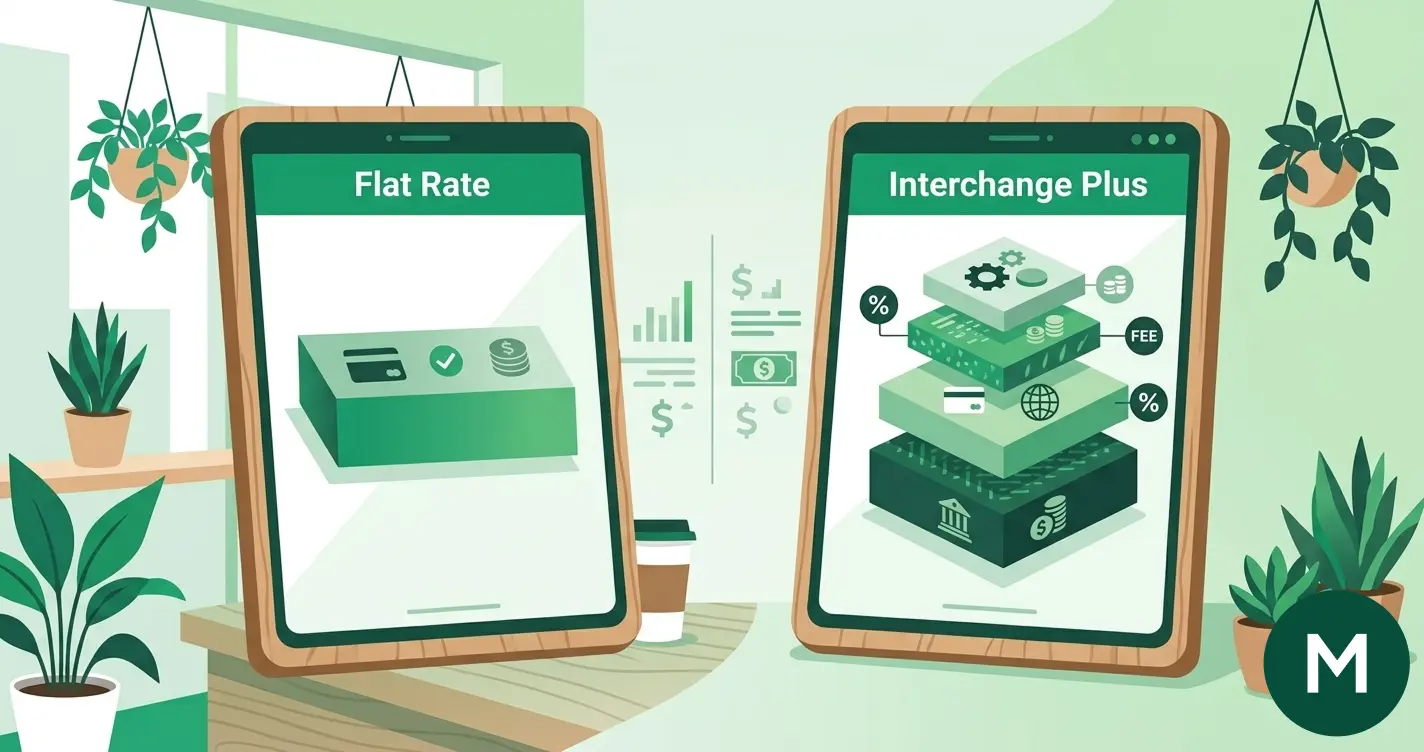
Interchange is the wholesale fee a card issuer (your customer's bank) charges the acquirer (your payments provider) on every transaction. The acquirer passes it through to you either explicitly (interchange-plus pricing) or implicitly (flat-rate pricing).
Today, the average interchange rate on a Visa or Mastercard consumer credit transaction in Australia sits in the 0.5% to 0.8% band, with premium cards higher. From 1 October 2026, the weighted average cap drops to 0.30%, bringing Australia roughly into line with European Union and United Kingdom rules.
What it means for your bill depends on how your provider prices.
If you are on interchange-plus pricing, the saving flows straight through. The lower wholesale rate appears on your statement from October. Merchants on Adyen, on the big four banks' negotiated plans, or on Stripe's interchange-plus tier (Stripe provider page) sit in this bucket.
If you are on flat-rate pricing (Zeller, Square, SumUp, Tyro (Tyro provider page), most CommBank Smart plans), the cap does not automatically reduce your rate. The provider keeps the saving as margin unless competitive pressure forces a cut. The first to cut in public is CommBank: its single flat in-store rate falls from 1.10% to 0.99% (including GST) on 1 October 2026, and existing customers on Smart Mini, Smart and Smart Integrated move to it automatically. On interchange-plus plans, CommBank says it will pass the new caps through by adjusting the interchange fees automatically. That is the case even where a provider will negotiate: Tyro publishes one flat rate and quotes individually above $20,000 a month, but a quote is still a blended rate rather than interchange passed through at cost.
The practical takeaway: interchange-plus customers should see lower statements from October without doing anything. Flat-rate customers should watch the market over Q4 2026 and Q1 2027 for rate cuts, and renegotiate or switch if their provider does not pass any benefit through.
The $910M question, does the wholesale cut reach merchants?
The RBA estimates that the interchange caps on domestic-issued cards will lower wholesale card payment costs for merchants by around $910 million a year. Wholesale is the load-bearing word. The reduction lands first on what acquirers pay, and it reaches a business only if its acquirer passes it on: interchange-plus customers get it automatically, flat-rate customers get it only if their provider chooses to move.
Surcharge removal is a separate flow, and it is not a saving to merchants at all. The RBA puts consumers at $1.6 billion of the $1.8 billion in card surcharges charged each year, so removing them is overwhelmingly a consumer benefit, and for the 16% of merchants who surcharge today it is a transfer of cost onto the business.
That leaves a second question, about what happens to shelf prices once a surcharge is folded into them. Two outcomes are realistic.
Merchants keep the markup. Businesses that already price in their surcharges (the corner cafe charging 1.5% on cards today) keep the markup but lose the surcharge line on the receipt. Headline prices stay where they are, and the markup becomes margin.
Customers see modest price falls in commoditised categories. In coffee, takeaway, and high-frequency convenience retail, competitive pressure may force one or two operators to drop headline prices once the surcharge line disappears, and others will follow.
The realistic split, at least through the first twelve months, is heavily weighted toward merchant retention. Larger chains with publicly listed pricing and strong competition (quick-service restaurants, supermarkets) face the most pressure to hold headline prices down. Independent operators are more likely to keep the markup.
What merchants should do right now
Five practical steps, in order of priority.
-
Audit your current effective rate. Pull the last three months of merchant statements and divide total fees by total card turnover. That single number, expressed as a percentage, is your real cost of payments. Most businesses are surprised at what they find. Once you have it, benchmark against the live rates on our comparison page to see whether you are paying more than market, or run your figures through the surcharge ban calculator to see how much surcharge revenue the ban removes and what switching provider could save.
-
Check your contract for a zero-cost or surcharge-pass clause. If your plan relies on the surcharge to keep your fees at zero, the model breaks on 1 October. Contact your provider now and ask for a written quote on their flat-rate alternative. Get it in writing before queues build through August and September.
-
Decide between flat-rate and interchange-plus. Small to medium merchants doing under $1 million a year in card turnover almost always come out ahead on flat-rate (Zeller, Square, SumUp, CommBank Smart). Mid-sized venues over $1 million, particularly those with steady debit volume, usually save with interchange-plus (Stripe, Adyen, the big four banks). The crossover point sits around $80,000 to $100,000 a month, but it varies by mix. A third option sits between the two: providers that publish a flat rate but negotiate above a stated volume, which is how Tyro prices.
-
Update your menu, signage, and online checkout. Surcharge notices on doors, menus, EFTPOS terminals, and online checkout flows need to come down or change wording before 1 October. If you were absorbing the surcharge into customer pricing, this is the moment to rework headline prices and communicate the change to repeat customers ahead of time. Holding off until the day will look reactive.
-
Get help if your statement is complicated. Businesses with multiple terminals, AMEX volume, international card exposure, or interchange-plus pricing often leave money on the table because the math is hard. Our services team does one-on-one statement reviews and provider negotiation for a flat fee.
Provider rates at a glance
We track 21 providers competing for small and mid-sized Australian merchant business. Headline rates below are read live from our database.
| Provider | In-person | Online | Monthly fee | Best for |
|---|---|---|---|---|
| Zeller | 1.4% (incl. GST) | 1.7% + $0.25 | Free | Flat-rate hospitality and retail |
| Square | 1.6% | 2.2% | Free | No-lock-in small business |
| CommBank Smart | 1.1% | quote | $29.50/mo | Existing CommBank customers |
| SumUp | 1.4% | 2.1% | Free | Tradies and pop-ups |
| Tyro | 1.3% (incl. GST) | 1.5% + $0.20 | From $19/mo rental | Mid-sized venues on an existing POS |
| Stripe | 1.7% + $0.10 | 1.7% + $0.30 | Free | E-commerce and SaaS |
| NAB | 1.15% flat | 1.4% + $0.25 | $25/mo rental | NAB business customers |
| Westpac | 1.2% flat | 1.4% | $24.75/mo rental | Westpac business customers |
Compare live rates and run a fee calculation at our comparison page.
Frequently asked questions
When does the RBA surcharge ban take effect?
The ban takes effect on 1 October 2026, the same day the 0.3% interchange cap on consumer credit cards begins. The RBA announced the package on 31 March 2026, giving merchants and acquirers six months to update contracts, pricing, signage, and point-of-sale systems.
Which payment providers let me surcharge, and what rate do they charge?
Almost every provider in our Australian dataset supports surcharging; Checkout.com and Clover do not offer it here. Almost none of them publish a surcharge rate, because in Australia the merchant sets the surcharge and the law caps it at that merchant's own cost of acceptance. The exceptions are Pin Payments, which calculates the surcharge to exactly equal its own fee (1.6% + 30c on a domestic card), and three providers that publish a ceiling: Stripe at 4%, Till Payments at 3%, and Westpac at 6% on OnlinePay. Those ceilings are platform limits, not entitlements. Your legal cap is still your cost of acceptance, which is almost always lower. Most of these providers are switching surcharging off around 1 October, and some earlier: Westpac from 25 September and Airwallex on 28 September. The table above shows what each provider has said.
Can I still surcharge AMEX or Diners after October 2026?
Not American Express, and Diners Club only if your provider still allows it. The RBA's designation covers EFTPOS, Visa, and Mastercard, and the RBA reports that American Express, UnionPay and PayPal have also decided to remove surcharging (PayPal from 5 October 2026). CommBank reports that JCB is doing the same. Diners Club is not on the RBA's list, but several providers are switching surcharging off for every card type they process, and Adyen tells its merchants that Diners surcharging ends on 1 October too. Buy Now Pay Later stays subject to each BNPL provider's own merchant rules. If you surcharge AMEX today, treat 1 October as your deadline as well.
What happens to my zero-cost EFTPOS plan?
The pass-through model that makes zero-cost EFTPOS work is no longer legal for Visa, Mastercard, and EFTPOS transactions from 1 October 2026. You will either absorb the fee on the same provider's flat-rate plan or switch to a competitive flat-rate offer. Compare the alternatives on our comparison page.
Will the 0.3% interchange cap reduce my fees automatically?
Only if you are on interchange-plus pricing. The new cap applies to the wholesale fee that your provider pays, and on interchange-plus the cost is passed straight through. If you are on flat-rate pricing, your headline rate does not move unless your provider chooses to cut it in response to competitive pressure.
Can I just raise my prices to cover the fee?
Yes. Repricing your menu or product list to cover the cost of card acceptance is the standard response, and the simplest. The rule is that you cannot itemise the cost as a card surcharge on the receipt. You can absorb it into headline prices freely.
What about BNPL services like Afterpay and Zip?
BNPL transactions are not covered by the surcharge ban. You can still pass on the BNPL fee to the customer, subject to the rules each BNPL provider sets in your merchant agreement. Some BNPL contracts prohibit surcharging directly, so check your terms before relying on it.
The bottom line
1 October 2026 is a hard deadline. Every Australian business that accepts a card needs to know what their effective rate will look like on the day, whether their current contract still makes sense, and how they will communicate any price changes to their customers. The work to do that takes hours, not weeks, but it has to happen before the queues fill up at acquirer support desks in late September.
Work out your exposure with the surcharge ban calculator, then compare Australian payment providers and run a fee calculation, all in under five minutes. If your statement is complicated or you want a human in the loop, our services team reviews statements and negotiates with providers on your behalf.